
This wallet received at least 1,000 USDC per month for the last three months.A verifier can check the claim without seeing the worker’s full financial history.
How It Works
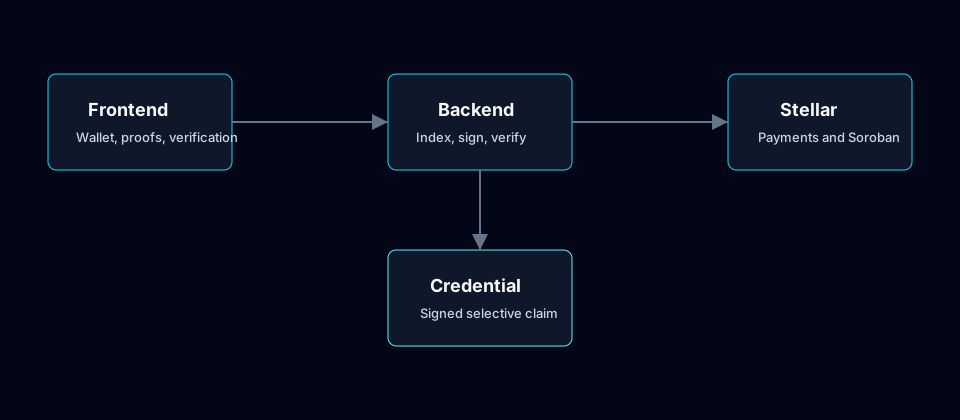 EarnProof combines a web application, backend API, signed credentials, and Soroban contracts.
- A worker connects Freighter on Stellar testnet.
- The backend authenticates the wallet through a signed challenge.
- The backend indexes incoming Stellar payments.
- The worker classifies qualifying income payments.
- The backend evaluates a proof condition and signs a credential.
- The worker shares a verification link or QR code.
- A verifier checks signature, expiration, revocation, issuer status, and disclosed claim.
Key Features
- Selective disclosure — prove a claim without revealing unrelated transactions.
- Stellar-native payments — start with public testnet payment activity.
- Signed credentials — use deterministic payloads and cryptographic signatures.
- Revocation support — invalidate shared proofs after issuance.
- Soroban trust layer — use issuer and proof registries without storing private income data on-chain.
- Open-source architecture — separate frontend, backend, contracts, SDK, docs, and specification repositories.
MVP Scope
The first implementation targets:Documentation
Getting Started
- Getting Started — run the local stack and understand the repository layout
- Roadmap — delivery order and future protocol direction
Architecture
- Architecture Overview — system components and trust boundaries
- Privacy Model — what is disclosed and what stays hidden
- Credential Lifecycle — creation, verification, expiration, and revocation
- Data Model — core backend entities
Guides
- Wallet Authentication — signed challenge flow
- Payment Indexing — Stellar payment discovery and normalization
- Create an Income Proof — proof inputs and disclosure preview
- Public Verification — verifier result states
- Revocation — proof invalidation flow
Contracts
- Contracts Overview — Soroban trust layer
- Protocol Config — admin, pause, and schema controls
- Issuer Registry — issuer status and metadata
- Proof Registry — commitments and revocation